
Baby Teeth vs. Reality: When Should You See an Orthodontist?
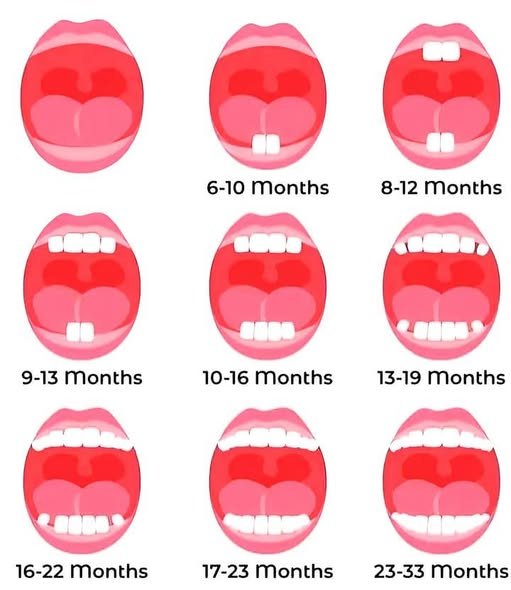
If you're a parent, you've probably already come across a baby teething chart on social media or in a pediatric guide. These charts show the average age at which each tooth is expected to come in: the lower central incisors between 6 and 10 months, the first molars around 13 months, and so on.
As parents, we sometimes tend to treat these charts as absolute rules. If your child's first tooth hasn't come in by 10 months, you may start to worry.
However, biological development varies greatly from one child to another. This variability is entirely normal in clinical practice.
In this article, we'll take a look at these charts, explain why the exact timeline matters less than you might think, and reveal what professionals actually look for when it comes to your child's dental health.
Baby Teeth Timeline: Why Every Child Develops at Their Own Pace
It is common for a child to deviate from statistical averages. For example, some babies don't get their first tooth until they are 11 months old. Is this abnormal? Not necessarily.
As long as the teeth are erupting and developing healthily, a delay in timing is not a cause for concern in and of itself.
The Role of Averages
The charts available online compile global statistical data. They do not take into account:
Genetic factors: The timing of tooth eruption in parents often influences that of their children.
Overall Development: The order of growth priorities varies from one infant to another.
Key takeaway: What matters is the steady progression of dental development, not the speed at which teeth come in.
The Order in Which Teeth Appear: The Eruption Sequence
While the exact age at which teething begins is of secondary importance, the order in which the teeth appear (the eruption sequence) is of great clinical significance. It is this aspect that allows us to confirm that the space in the jaw is being properly guided.
As a general rule, the eruption follows a specific sequence to make the best use of the available space:
The two lower central incisors (at the bottom, in the middle).
The two upper central incisors (at the top, in the middle).
The lateral incisors, followed by the first molars, the canines, and the second molars.
Why monitor the sequence?
A major disruption in this sequence may signal potential challenges for future alignment. If, for example, the back molars begin to erupt before the front incisors have come in, this may indicate a lack of space or an underlying obstruction.
A change in the eruption pattern can:
Reserve the space needed for future permanent teeth.
Result in significant overlaps.
Modify the jaw's closing path during growth.
If you notice any irregularities in the order in which your child's teeth are coming in, a consultation can provide an accurate assessment.
Why is age 7 recommended for an initial evaluation?
The American Association of Orthodontists recommends scheduling an initial orthodontic evaluation as early as age 7.
At this stage, the dentition is referred to as "mixed," consisting of a combination of baby teeth and the first permanent teeth. This is the ideal time to assess the structural relationships between the jaws, even if the visible teeth appear straight.
What is interceptive orthodontics (Phase 1)?
Early intervention, often referred to as Phase 1 or interceptive treatment, is not intended to involve placing full braces on all teeth. Rather, it allows for:
To support the growth of bone structures in order to correct significant misalignments between the upper and lower jaws.
Preserving or creating the space needed for permanent teeth to erupt, which can reduce the complexity of treatments during adolescence.
Detect crossbites to prevent premature wear or asymmetric growth.
Modern support tools for families in Montreal and on the South Shore
We understand that managing family schedules—whether in Montreal or on the South Shore—requires a great deal of flexibility.
That’s why our approach incorporates remote imaging and monitoring technologies (such as the Dental Monitoring app and the Scanbox). These tools allow our clinical team to monitor your child’s dental development and growth remotely, thereby reducing the frequency of required in-office visits. You benefit from thorough monitoring while optimizing your work and personal travel between our locations in Côte-des-Neiges and Saint-Hubert.
Ready to take the plunge for your child's smile?
Do you have questions about your child's dental development? Avoid the uncertainty associated with generic online tools.
Please take a few moments to fill out our online intake questionnaire. This will help our clinical team understand your goals and prepare for your first visit to the clinic.